


[[ data.name ]]
[[ data.ticker ]]
[[ data.price ]] [[ data.change ]] ([[ data.changePercent ]]%)
Low: [[ data.low ]]
High: [[ data.high ]]
About
History
Why trade?
About
History
Why trade?
EUR/GBP is a currency pair that shows how many British pounds (GBP) are needed to buy one euro (EUR). For example, if the EUR/GBP rate is 0.88, one euro is worth 0.88 British pounds, so buying EUR 10,000 would cost £8,800.
The euro is the common currency of the eurozone, and its monetary policy is set by the European Central Bank (ECB). The pound sterling is the currency of the United Kingdom, where monetary policy is set by the Bank of England (BoE). The UK never adopted the euro and left the European Union on 31 January 2020.
EUR/GBP is one of the most widely traded cross-currency pairs, reflecting the close trade links between the UK and the eurozone. The exchange rate is affected by factors such as ECB and BoE interest rate decisions, inflation and growth data, political events and trade relations between the UK and the EU.
The euro was introduced on 1 January 1999. In its early years the euro weakened, and EUR/GBP reached its all-time low of around 0.57 in May 2000.
The euro then strengthened against the pound for several years. During the global financial crisis, the Bank of England cut interest rates sharply and the pound fell. At the end of December 2008, EUR/GBP reached its all-time high of around 0.98, close to parity.
The pair moved sharply after the UK's EU referendum on 23 June 2016, when the pound fell following the vote to leave. Since then, Brexit-related developments, central bank policy, inflation and economic data have continued to drive EUR/GBP. Past performance is not a reliable indicator of future results.
Traders follow EUR/GBP because it reflects the relationship between two closely linked European economies. Interest rate decisions by the ECB and the Bank of England, economic data releases and political events in the UK and the EU can move the pair. These price movements can create trading opportunities, but they can also lead to losses, especially when trading with leverage.
EUR/GBP can be traded as a CFD (contract for difference), which lets you speculate on price movements in either direction without owning the underlying currencies. CFDs are leveraged products and carry a high level of risk.
Other currency pairs that traders may consider include EUR/USD, GBP/USD, USD/JPY and AUD/USD. The choice of currency pair depends on factors such as liquidity, volatility and each trader's strategy and risk tolerance. It's important to research any currency pair carefully and understand the risks before trading.
| Swap long | [[ data.swapLong ]] points |
|---|---|
| Swap short | [[ data.swapShort ]] points |
| Spread min | [[ data.stats.minSpread ]] |
| Spread avg | [[ data.stats.avgSpread ]] |
| Min contract size | [[ data.minVolume ]] |
| Min step size | [[ data.stepVolume ]] |
| Commission and Swap | Commission and Swap |
| Leverage | Leverage |
| Trading Hours | Trading Hours |
* The spreads provided are a reflection of the time-weighted average. Though TradingMoon attempts to provide competitive spreads during all trading hours, clients should note that these may vary and are susceptible to underlying market conditions. The above is provided for indicative purposes only. Clients are advised to check important news announcements on our Economic Calendar, which may result in the widening of spreads, amongst other instances.
The above spreads are applicable under normal trading conditions. TradingMoon has the right to amend the above spreads according to market conditions as per the 'Terms and Conditions'.
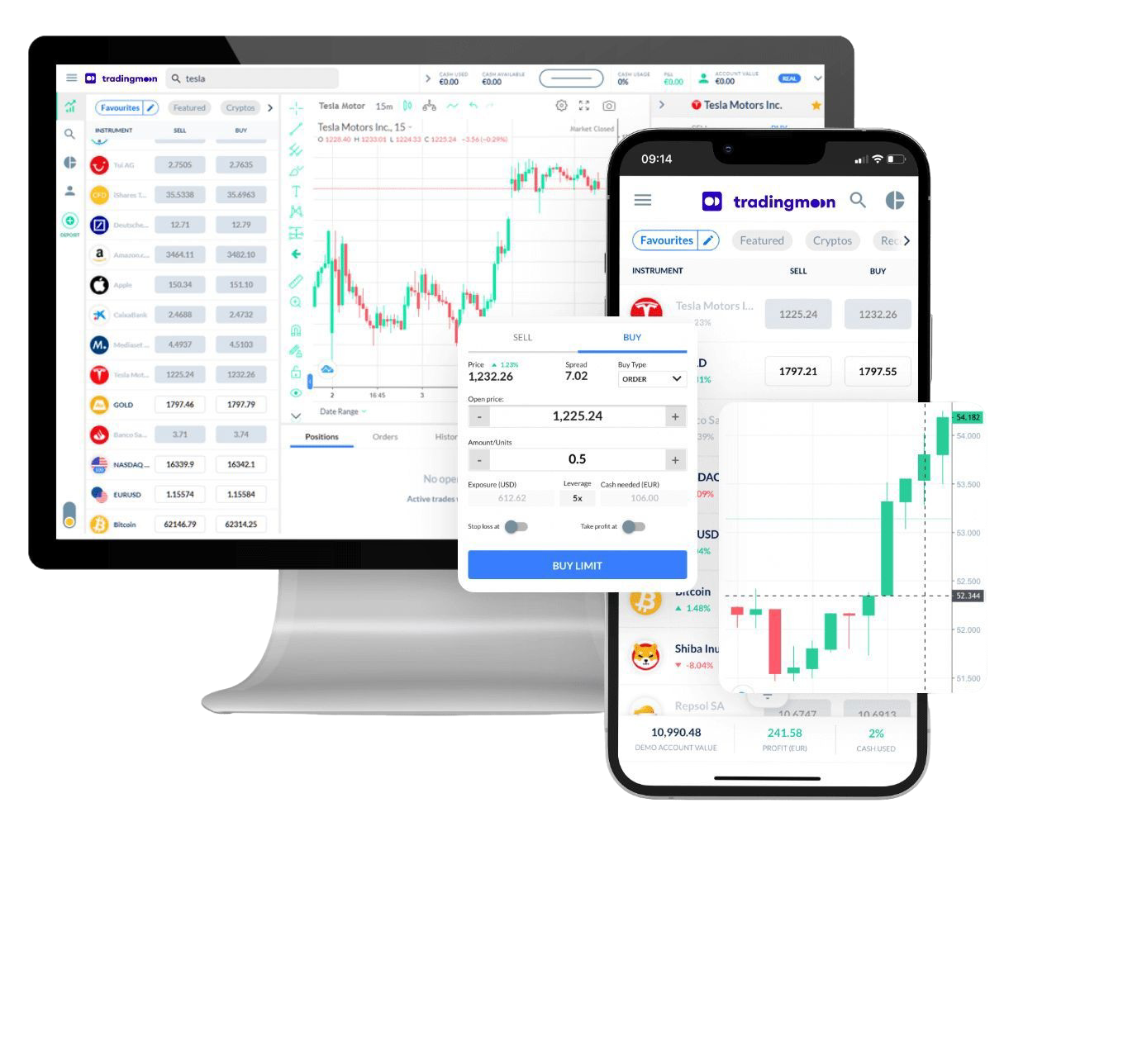
Trade [[data.name]] with TradingMoon
Hassle-free, with flexible trade sizes, and super low spreads!
- Spreads starting at 0.2!
- Average Execution at 5ms
- Easy to use platform
*Other fees may apply.
FAQs
What affects the currency pair EUR GBP?
The EUR/GBP exchange rate is affected by a variety of factors. These can include macroeconomic trends such as GDP growth, unemployment rates, inflation levels and interest rate decisions made by the European Central Bank (ECB) and the Bank of England (BOE). Political events like Brexit negotiations or elections can also have an impact on the EUR/GBP rate. Other factors such as the performance of other currencies like the US dollar or Japanese yen can also affect this pair.
When is the best time to trade the EUR/GBP?
The EUR/GBP is a popular currency pair for traders, due to the close relationship between the two economies and its relatively high liquidity. When deciding when to trade the EUR/GBP, it is important to consider both short-term and long-term market trends.
In the short term, the best time to trade the EUR/GBP is during London hours when both the UK and European markets are open. Trading activity tends to be highest during this period, which can result in more favorable prices. In the long term, it is important to monitor key economic indicators from both countries that could affect the performance of their respective currencies.
How to trade EURGBP?
The Euro and Pound are strongly correlated with each other, meaning that they tend to move in tandem. However, their movements can be impacted by a number of different factors such as political events or economic news from either region. It is therefore important to stay up to date with geopolitical and economic events in both the U.K. and European Union, as these will have an effect on the EURGBP rate.
Another factor that should be taken into consideration when trading EURGBP is the potential for large price swings. This currency pair is known for its volatility and can be subject to rapid price changes due to a variety of factors. Traders should also be aware of any commissions or fees they may incur while trading EURGBP. When trading EURGBP it is important to use risk management techniques in order to protect your capital. By setting stop-loss and take-profit orders, traders can limit their losses if the market moves against them.
Why Trade [[data.name]]
Make the most of price fluctuations - no matter what direction the price swings and with low capital investment.
Forex

Capitalise on rising prices (go long)


Capitalise on falling prices (go short)

Trade with leverage

Trade on volatility

Enjoy huge liquidity

Manage risk with in-platform tools
Ability to set take profit and stop loss levels