


[[ data.name ]]
[[ data.ticker ]]
[[ data.price ]] [[ data.change ]] ([[ data.changePercent ]]%)
Low: [[ data.low ]]
High: [[ data.high ]]
About
History
Why trade?
About
History
Why trade?
EUR/NZD is a currency pair that shows how many New Zealand dollars (NZD) are needed to buy one euro (EUR). For example, if the EUR/NZD rate is 1.90, one euro is worth 1.90 New Zealand dollars, so buying EUR 1,000 would cost NZD 1,900.
The euro is the common currency of the eurozone, and its monetary policy is set by the European Central Bank (ECB). The New Zealand dollar, often called the "kiwi", is the currency of New Zealand, where monetary policy is set by the Reserve Bank of New Zealand (RBNZ). Dairy is New Zealand's largest export, so the New Zealand dollar can be sensitive to dairy prices and to demand from major trading partners such as China and Australia.
EUR/NZD is a cross pair, as it does not include the US dollar. The exchange rate is affected by factors such as ECB and RBNZ interest rate decisions, inflation and growth data, commodity prices and global risk sentiment.
The euro was introduced on 1 January 1999, and EUR/NZD has been traded since then. The New Zealand dollar has floated freely since March 1985. In 1990, New Zealand became the first country to formally adopt inflation targeting, under the Reserve Bank of New Zealand Act 1989.
Over the years, EUR/NZD has moved through wide swings. The pair has been affected by events such as the 2008 global financial crisis, the eurozone debt crisis, changes in dairy prices and the COVID-19 pandemic.
Interest rate differences between the eurozone and New Zealand, commodity prices and global risk sentiment continue to drive EUR/NZD. Past performance is not a reliable indicator of future results.
Traders follow EUR/NZD because it pairs the euro with the currency of a commodity-exporting economy in the Asia-Pacific region. Interest rate decisions by the ECB and the RBNZ, economic data from New Zealand and the eurozone, dairy and other commodity prices, and changes in global risk sentiment can move the pair, sometimes sharply. These price movements can create trading opportunities, but they can also lead to losses, especially when trading with leverage.
EUR/NZD can be traded as a CFD (contract for difference), which lets you speculate on price movements in either direction without owning the underlying currencies. CFDs are leveraged products and carry a high level of risk.
Other currency pairs that traders may consider include EUR/USD, GBP/USD, USD/JPY and AUD/USD. The choice of currency pair depends on factors such as liquidity, volatility and each trader's strategy and risk tolerance. It's important to research any currency pair carefully and understand the risks before trading.
| Swap long | [[ data.swapLong ]] points |
|---|---|
| Swap short | [[ data.swapShort ]] points |
| Spread min | [[ data.stats.minSpread ]] |
| Spread avg | [[ data.stats.avgSpread ]] |
| Min contract size | [[ data.minVolume ]] |
| Min step size | [[ data.stepVolume ]] |
| Commission and Swap | Commission and Swap |
| Leverage | Leverage |
| Trading Hours | Trading Hours |
* The spreads provided are a reflection of the time-weighted average. Though TradingMoon attempts to provide competitive spreads during all trading hours, clients should note that these may vary and are susceptible to underlying market conditions. The above is provided for indicative purposes only. Clients are advised to check important news announcements on our Economic Calendar, which may result in the widening of spreads, amongst other instances.
The above spreads are applicable under normal trading conditions. TradingMoon has the right to amend the above spreads according to market conditions as per the 'Terms and Conditions'.
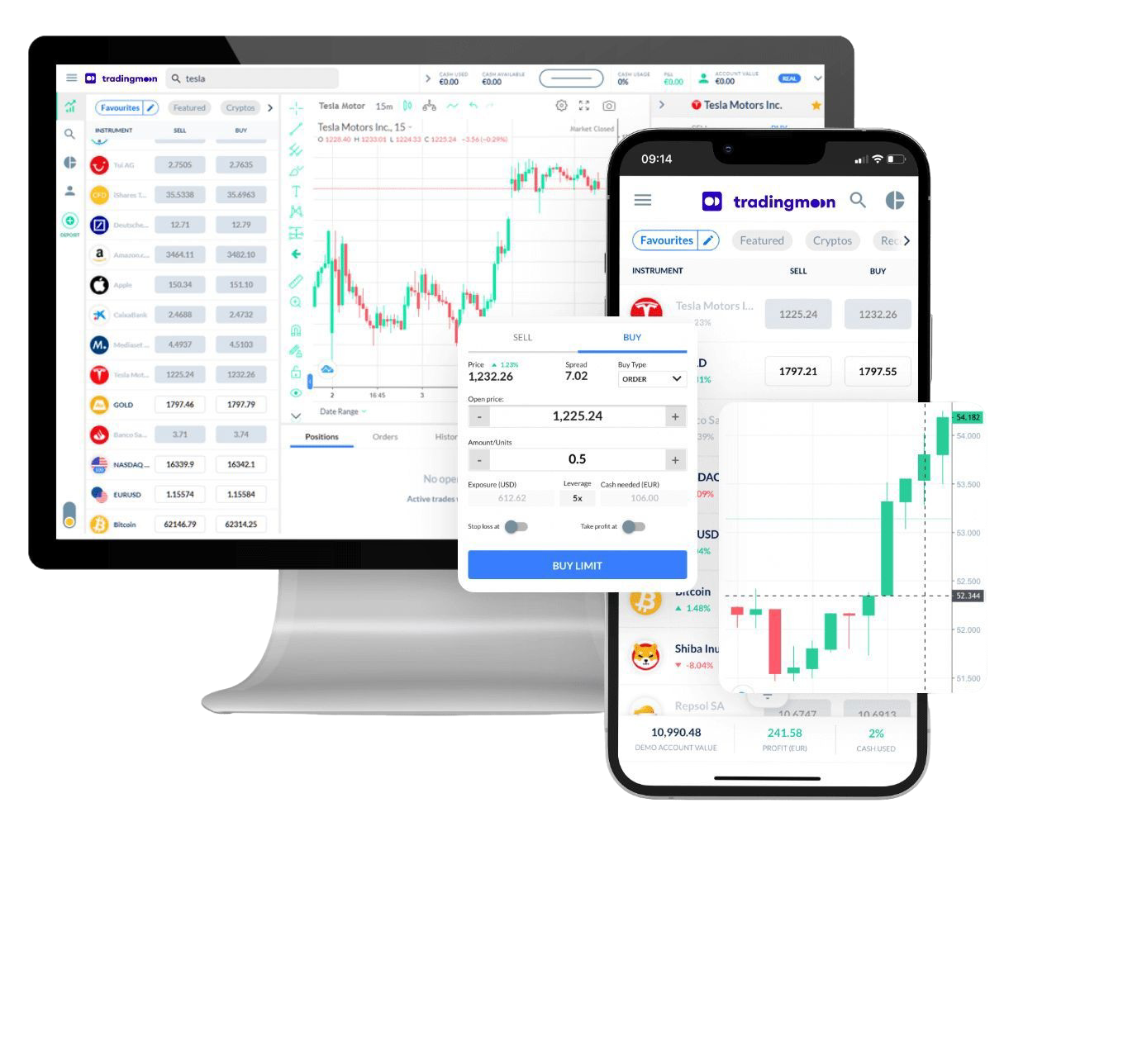
Trade [[data.name]] with TradingMoon
Hassle-free, with flexible trade sizes, and super low spreads!
- Spreads starting at 0.2!
- Average Execution at 5ms
- Easy to use platform
*Other fees may apply.
Why Trade [[data.name]]
Make the most of price fluctuations - no matter what direction the price swings and with low capital investment.
Forex

Capitalise on rising prices (go long)


Capitalise on falling prices (go short)

Trade with leverage

Trade on volatility

Enjoy huge liquidity

Manage risk with in-platform tools
Ability to set take profit and stop loss levels