


This website is operated by TM Trading Ltd, an entity regulated by the Seychelles Financial Services Authority (FSA) with License No. SD042. This website is not intended for EU residents or individuals in jurisdictions where its access is restricted by law.
By clicking "Acknowledge", you confirm that you are accessing this website on your own initiative and not in response to any direct marketing or solicitation, and you understand that you are not protected by EU regulations. You acknowledge that you are seeking information from this website under the principle of reverse solicitation, in accordance with the applicable laws of your home jurisdiction.
[[ data.name ]]
[[ data.ticker ]]
[[ data.price ]] [[ data.change ]] ([[ data.changePercent ]]%)
Low: [[ data.low ]]
High: [[ data.high ]]
About
History
Why trade EURSEK?
About
History
Why trade EURSEK?
EUR/SEK is a currency pair that shows how many Swedish kronor (SEK) are needed to buy one euro (EUR). For example, if the EUR/SEK rate is 11, one euro is worth 11 kronor, so buying EUR 100 would cost SEK 1,100.
The euro is the common currency of the eurozone, and its monetary policy is set by the European Central Bank (ECB). The krona is the currency of Sweden, which is a member of the European Union but has not adopted the euro. Sweden's monetary policy is set by the Riksbank, which targets inflation of 2%. One krona is divided into 100 öre.
EUR/SEK is a cross pair, as it does not include the US dollar. The exchange rate is affected by factors such as interest rate decisions by the ECB and the Riksbank, inflation and growth data, trade between Sweden and the eurozone, and global risk sentiment.
The Swedish krona was introduced in 1873, when Sweden and Denmark formed the Scandinavian Monetary Union and linked their currencies to gold. Norway joined in 1875, and the union lasted until World War I. The euro was introduced on 1 January 1999, and EUR/SEK has been traded since then.
Sweden abandoned its fixed exchange rate on 19 November 1992, and the krona has floated since then. In 1993, the Riksbank announced an inflation target of 2%, which began to apply in 1995. In a referendum in September 2003, 56% of Swedish voters rejected adopting the euro, so Sweden kept the krona.
EUR/SEK has moved through several large swings. The krona weakened against the euro during the 2008–2009 financial crisis, and in 2023 it fell to its weakest level against the euro since 1999, close to SEK 12 per euro. Past performance is not a reliable indicator of future results.
Traders follow EUR/SEK because it pairs the euro with the currency of an EU country that has kept its own currency. Interest rate decisions by the ECB and the Riksbank, inflation data and changes in global risk sentiment can move the pair, and the krona has often weakened in periods of financial market stress. EUR/SEK is generally less liquid than the major pairs, so spreads may be wider, and price movements can lead to substantial losses, especially when trading with leverage.
EUR/SEK can be traded as a CFD (contract for difference), which lets you speculate on price movements in either direction without owning the underlying currencies. CFDs are leveraged products and carry a high level of risk.
Other currency pairs that traders may consider include EUR/USD, GBP/USD, USD/JPY and AUD/USD. The choice of currency pair depends on factors such as liquidity, volatility and each trader's strategy and risk tolerance. It's important to research any currency pair carefully and understand the risks before trading.
Loading
| Swap long | [[ data.swapLong ]] points |
|---|---|
| Swap short | [[ data.swapShort ]] points |
| Spread min | [[ data.stats.minSpread ]] |
| Spread avg | [[ data.stats.avgSpread ]] |
| Min contract size | [[ data.minVolume ]] |
| Min step size | [[ data.stepVolume ]] |
| Commission and Swap | Commission and Swap |
| Leverage | Leverage |
| Trading Hours | Trading Hours |
* The spreads provided are a reflection of the time-weighted average. Though TradingMoon attempts to provide competitive spreads during all trading hours, clients should note that these may vary and are susceptible to underlying market conditions. The above is provided for indicative purposes only. Clients are advised to check important news announcements on our Economic Calendar, which may result in the widening of spreads, amongst other instances.
The above spreads are applicable under normal trading conditions. TradingMoon has the right to amend the above spreads according to market conditions as per the 'Terms and Conditions'.
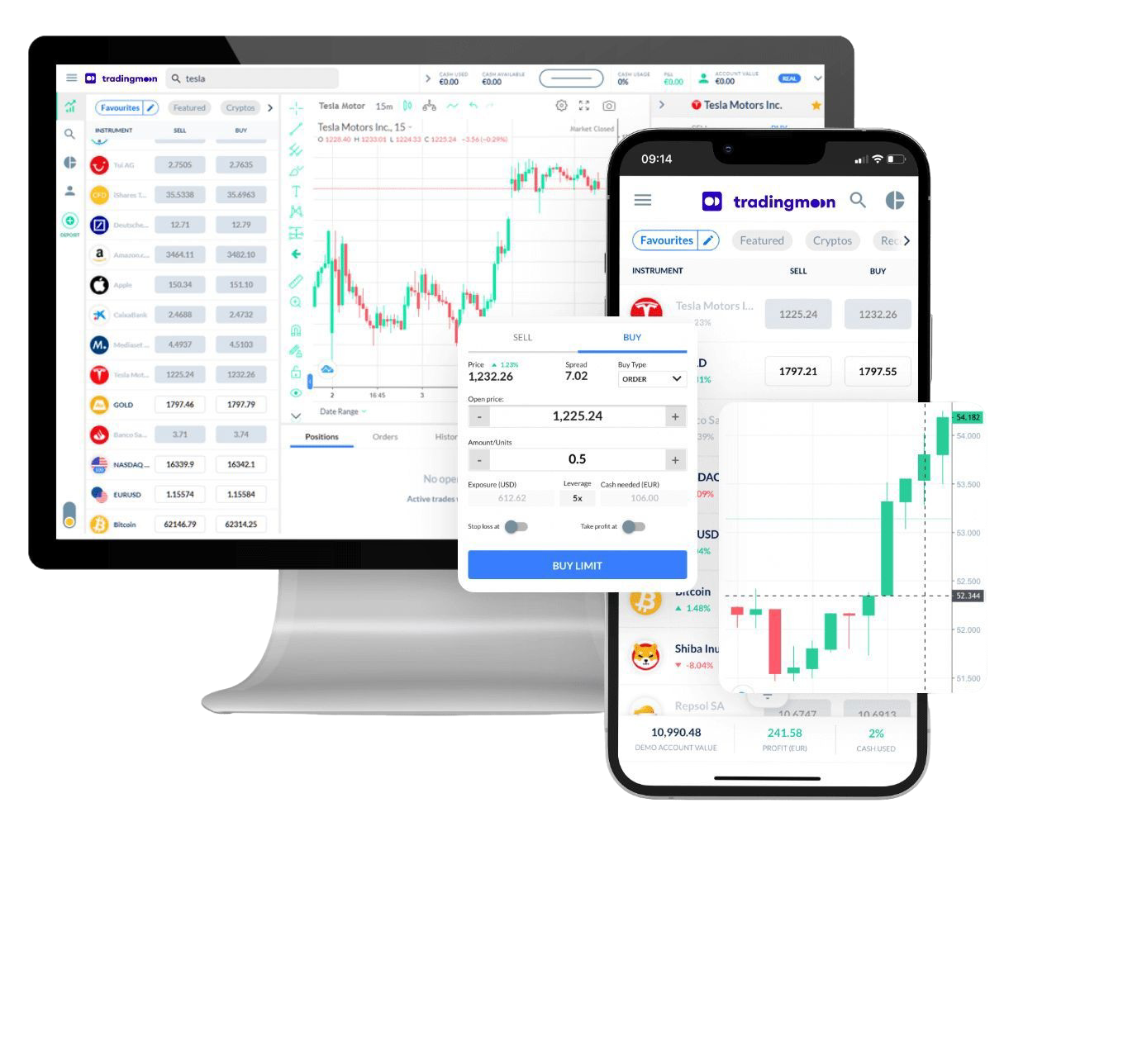
Trade [[data.name]] with TradingMoon
Hassle-free, with flexible trade sizes, and super low spreads!
- Spreads starting at 0.2!
- Average Execution at 5ms
- Easy to use platform
*Other fees may apply.
FAQs
What affects the currency pair EUR SEK?
The EUR/SEK exchange rate is affected by economic and geopolitical factors such as economic growth, inflation, government policies and investor sentiment.
Inflation in the eurozone and in Sweden influences interest rate decisions by the European Central Bank (ECB) and the Riksbank. Changes in interest rates, or in expectations of future rate changes, can move the euro and the krona relative to each other.
Investor sentiment also plays a role. In periods of financial market stress, the krona has often weakened, while improving sentiment can support it.
When is the best time to trade the EUR/SEK?
EUR/SEK can move sharply, so trading it involves risk. The best time to trade depends on your trading style and strategy.
For short-term traders who focus on intraday movements, the pair is usually most active during European trading hours, when markets in Stockholm, Frankfurt and London are open (roughly 9:00–17:30 CET). Spreads may be tighter when liquidity is higher.
Longer-term traders may focus on news that can affect the EUR/SEK rate, such as interest rate decisions, GDP figures or inflation data. These releases usually follow a regular schedule and can be found in advance in an economic calendar.
How to trade EURSEK?
EUR/SEK can be volatile, so it's important to understand how to manage risk when trading this pair. Here are some general points to consider:
1. Follow the news – Be aware of economic data, central bank decisions and other developments that could affect the EUR/SEK rate.
2. Use risk management tools – Stop-loss and limit orders can help you manage your risk, although a stop-loss may not always be executed at the exact price you set.
3. Consider technical analysis – Some traders use chart patterns and indicators to analyse price movements. No method can reliably predict future price movements, and trading with leverage can lead to substantial losses.
Why Trade [[data.name]]
Make the most of price fluctuations - no matter what direction the price swings and with low capital investment.
Forex

Capitalise on rising prices (go long)


Capitalise on falling prices (go short)

Trade with leverage

Trade on volatility

Enjoy huge liquidity

Manage risk with in-platform tools
Ability to set take profit and stop loss levels