


[[ data.name ]]
[[ data.ticker ]]
[[ data.price ]] [[ data.change ]] ([[ data.changePercent ]]%)
Low: [[ data.low ]]
High: [[ data.high ]]
About
History
Why Trade?
About
History
Why Trade?
EUR/SGD is a currency pair that shows how many Singapore dollars (SGD) are needed to buy one euro (EUR). For example, if the EUR/SGD rate is 1.5, one euro is worth 1.5 Singapore dollars, so buying EUR 100 would cost SGD 150.
The euro is the common currency of the eurozone, and its monetary policy is set by the European Central Bank (ECB), which mainly uses interest rates. Singapore's monetary policy works differently: since 1981, the Monetary Authority of Singapore (MAS) has used the exchange rate as its main tool. It manages the Singapore dollar against a trade-weighted basket of currencies (the S$NEER) within a policy band that it does not disclose.
EUR/SGD is a cross pair, as it does not include the US dollar, and it is less widely traded than the major pairs. The exchange rate is affected by factors such as ECB interest rate decisions, MAS policy statements, inflation and growth data, trade and global risk sentiment.
The Singapore dollar was introduced on 12 June 1967 by the Board of Commissioners of Currency, Singapore, replacing the Malaya and British Borneo dollar. It remained exchangeable at par with the Malaysian ringgit until 1973 and is still interchangeable at par with the Brunei dollar. The euro was introduced on 1 January 1999, and EUR/SGD has been traded since then.
In 1981, MAS made the exchange rate the focus of its monetary policy. In 2002, the Board of Commissioners of Currency merged with MAS, which took over the issuing of notes and coins. Since 2024, MAS has published its monetary policy statements four times a year, in January, April, July and October.
Over the years, EUR/SGD has been affected by events such as the 2008 global financial crisis, the eurozone debt crisis and the COVID-19 pandemic, as well as by changes in ECB and MAS policy. Past performance is not a reliable indicator of future results.
Traders follow EUR/SGD because it pairs the euro with the currency of a major Asian financial centre whose central bank manages monetary policy through the exchange rate. ECB interest rate decisions, MAS policy statements, inflation data and changes in global risk sentiment can move the pair. EUR/SGD is generally less liquid than the major pairs, so spreads may be wider, and price movements can lead to substantial losses, especially when trading with leverage.
EUR/SGD can be traded as a CFD (contract for difference), which lets you speculate on price movements in either direction without owning the underlying currencies. CFDs are leveraged products and carry a high level of risk.
Other currency pairs that traders may consider include EUR/USD, GBP/USD, USD/JPY and AUD/USD. The choice of currency pair depends on factors such as liquidity, volatility and each trader's strategy and risk tolerance. It's important to research any currency pair carefully and understand the risks before trading.
| Swap long | [[ data.swapLong ]] points |
|---|---|
| Swap short | [[ data.swapShort ]] points |
| Spread min | [[ data.stats.minSpread ]] |
| Spread avg | [[ data.stats.avgSpread ]] |
| Min contract size | [[ data.minVolume ]] |
| Min step size | [[ data.stepVolume ]] |
| Commission and Swap | Commission and Swap |
| Leverage | Leverage |
| Trading Hours | Trading Hours |
* The spreads provided are a reflection of the time-weighted average. Though TradingMoon attempts to provide competitive spreads during all trading hours, clients should note that these may vary and are susceptible to underlying market conditions. The above is provided for indicative purposes only. Clients are advised to check important news announcements on our Economic Calendar, which may result in the widening of spreads, amongst other instances.
The above spreads are applicable under normal trading conditions. TradingMoon has the right to amend the above spreads according to market conditions as per the 'Terms and Conditions'.
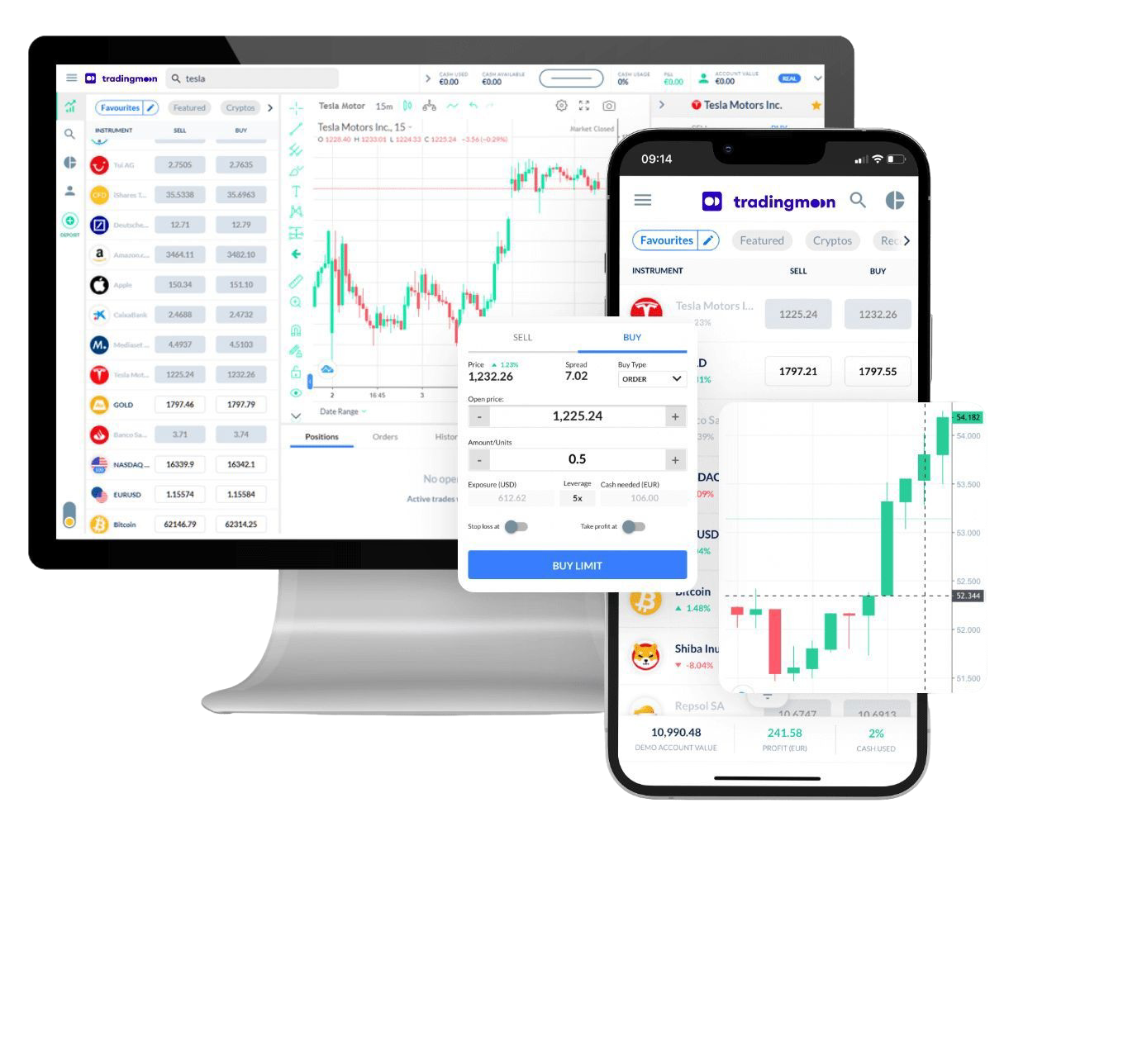
Trade [[data.name]] with TradingMoon
Hassle-free, with flexible trade sizes, and super low spreads!
- Spreads starting at 0.2!
- Average Execution at 5ms
- Easy to use platform
*Other fees may apply.
FAQs
What factors can affect the value of the EURSGD currency pair?
The EUR/SGD exchange rate can be affected by economic indicators such as GDP, inflation, employment and trade balances in the eurozone and Singapore.
Political events, such as elections and policy decisions, and geopolitical tensions can also move the pair. Monetary policy plays a key role too: the European Central Bank (ECB) sets interest rates for the eurozone, while the Monetary Authority of Singapore (MAS) manages the Singapore dollar through its exchange rate policy.
What trading strategies are suitable for EURSGD?
Traders often combine fundamental and technical analysis when looking at EUR/SGD. Fundamental analysis looks at economic data, interest rate differentials, geopolitical events and central bank policy in the eurozone and Singapore.
Technical analysis involves studying price charts, trend lines, support and resistance levels, and indicators such as moving averages or oscillators. Common approaches include trend following, range trading and breakout trading. Risk management, such as stop-loss orders and appropriate position sizing, can help limit losses, but no strategy guarantees results, and trading with leverage can lead to substantial losses.
How can I stay updated with news and trends related to EURSGD trading?
Financial news websites provide market updates, economic data releases and analysis, and newsletters or alerts from reputable news sources can bring relevant information to your inbox. Announcements from the European Central Bank (ECB) and the Monetary Authority of Singapore (MAS) are especially important, as their policy decisions can affect the EUR/SGD rate.
Some traders also follow market commentary from analysts on social media, but it is important to check how reliable a source is. Trading platforms with built-in news feeds and economic calendars can also help you keep track of key events and data releases.
Why Trade [[data.name]]
Make the most of price fluctuations - no matter what direction the price swings and with low capital investment.
Forex

Capitalise on rising prices (go long)


Capitalise on falling prices (go short)

Trade with leverage

Trade on volatility

Enjoy huge liquidity

Manage risk with in-platform tools
Ability to set take profit and stop loss levels