


[[ data.name ]]
[[ data.ticker ]]
[[ data.price ]] [[ data.change ]] ([[ data.changePercent ]]%)
Low: [[ data.low ]]
High: [[ data.high ]]
About
History
Differences between Investing vs Trading
About
History
Differences between Investing vs Trading
Salesforce is a cloud-based software company that was founded in 1999 by Marc Benioff. The company went public in 2004 and had a market capitalization of about $188 billion on 5 November 2026. Salesforce is best known for its customer relationship management (CRM) software, which helps businesses manage their customer data and automate various sales and marketing processes.
The company also offers a wide range of other enterprise software solutions, such as analytics, application development, and collaboration tools. Salesforce has over 150,000 customers worldwide, including many large businesses such as Coca-Cola, IBM, and Nike. The company has been awarded numerous accolades over the years, including being named one of the "World's Most Innovative Companies" by Forbes magazine.
Salesforce went public on the New York Stock Exchange in June 2004. Its share price reached a record of around $369 in December 2024, after quarterly results and the launch of its Agentforce AI platform. The shares then fell through 2025 and the first half of 2026, trading at around $156 at the end of June 2026, before recovering to about $228 in early November 2026.
There are several factors that can affect Salesforce's share price. One of the most important is the company's business partnerships. Salesforce has partnered with some of the biggest names in the tech industry, including Microsoft, Google, and Amazon. These partnerships give Salesforce access to new markets and customers, which can boost its share price. Another factor that can affect Salesforce's share price is the overall health of the economy. When the economy is doing well, businesses are more likely to invest in new software and technologies, which can benefit Salesforce. However, when the economy is struggling, businesses may be reluctant to spend money on new software, which can drag down Salesforce's share price.
When you invest in Salesforce shares, you are buying a piece of the company and becoming a shareholder. As a shareholder, you are entitled to a share of the company's profits (if any) and you have a say in how the company is run. Investing in Salesforce shares is a long-term investment, and you should be prepared to hold onto your shares for at least several years.
When you trade Salesforce CFDs, you are not buying shares in the company. Instead, you are speculating on the price of the shares. CFD trading is a more short-term approach, and you can trade Salesforce CFDs using leverage. This means that you can control a larger position than your actual investment, which can lead to higher profits (but also higher losses).
| Swap long | [[ data.swapLong ]] points |
|---|---|
| Swap short | [[ data.swapShort ]] points |
| Spread min | [[ data.stats.minSpread ]] |
| Spread avg | [[ data.stats.avgSpread ]] |
| Min contract size | [[ data.minVolume ]] |
| Min step size | [[ data.stepVolume ]] |
| Commission and Swap | Commission and Swap |
| Leverage | Leverage |
| Trading Hours | Trading Hours |
* The spreads provided are a reflection of the time-weighted average. Though TradingMoon attempts to provide competitive spreads during all trading hours, clients should note that these may vary and are susceptible to underlying market conditions. The above is provided for indicative purposes only. Clients are advised to check important news announcements on our Economic Calendar, which may result in the widening of spreads, amongst other instances.
The above spreads are applicable under normal trading conditions. TradingMoon has the right to amend the above spreads according to market conditions as per the 'Terms and Conditions'.
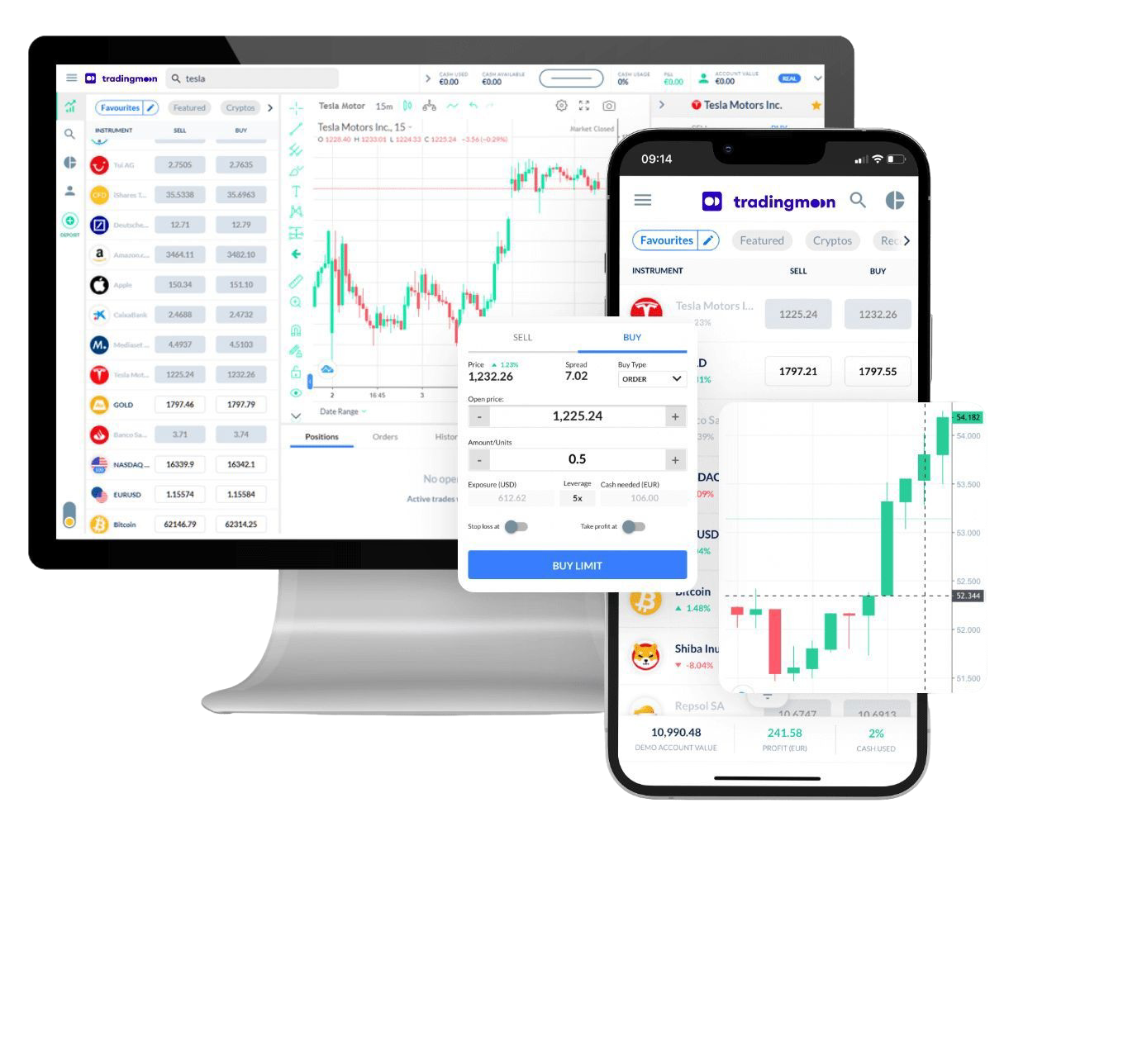
Trade [[data.name]] with TradingMoon
All Hassle-free, with flexible trade sizes and with zero commissions!*
- Trade 24/5
- Minimum margin requirements
- No commission, only spread
- Fractional shares available
- Easy to use platform
*Other fees may apply.
FAQs
Which are the competitors of Salesforce shares?
Salesforce competes with other providers of customer relationship management (CRM) and enterprise software, including Microsoft (Dynamics 365), Oracle, SAP, Adobe and HubSpot. Their products, pricing and features differ, and the competitive landscape can change over time.
Who owns most Salesforce shares?
According to Salesforce's 2026 proxy statement, the largest shareholders were institutional investors: The Vanguard Group held about 10.2% of the shares, BlackRock about 8.9% and State Street about 6.0%. Co-founder, Chair and CEO Marc Benioff held about 2.8%.
Shareholdings change over time, and the latest figures are published in the company's filings with the US Securities and Exchange Commission (SEC).
Do Salesforce shares pay dividends?
Yes. Salesforce paid its first quarterly dividend in April 2024, at $0.40 per share. The quarterly dividend was raised to $0.416 per share in 2025 and to $0.44 per share in 2026.
Future dividends are not guaranteed and depend on decisions by the company's board of directors.
Why Trade [[data.name]]
Make the most of price fluctuations - no matter what direction the price swings and without capital restrictions that come with buying the underlying asset.
CFDs
Equities

Capitalise on rising prices (go long)


Capitalise on falling prices (go short)

Trade with leverage
Hold larger positions than the cash you have at your disposal

Trade on volatility
No need to own the asset

No commissions
Just low spreads

Manage risk with in-platform tools
Ability to set take profit and stop loss levels