


[[ data.name ]]
[[ data.ticker ]]
[[ data.price ]] [[ data.change ]] ([[ data.changePercent ]]%)
Low: [[ data.low ]]
High: [[ data.high ]]
About
History
Why trade?
About
History
Why trade?
The AUDJPY currency pair shows how many Japanese yen (JPY) are needed to buy one Australian dollar (AUD). The Australian dollar is closely linked to commodity prices and to demand from major trading partners such as China, while the Japanese yen is often seen as a safe-haven currency. As a result, AUDJPY tends to be sensitive to changes in global risk sentiment.
Several factors can affect AUDJPY. These include interest rate decisions by the Reserve Bank of Australia and the Bank of Japan, the interest rate gap between the two countries, inflation and economic data, and changes in commodity prices. Global market sentiment and geopolitical events can also move the pair.
The Australian dollar and the Japanese yen are both widely traded currencies, and the AUDJPY exchange rate reflects how the two economies perform relative to each other, as well as shifts in global risk appetite. Because of the interest rate gap between Australia and Japan, the pair has often been used in carry trades, which can lead to sharp moves when investors reduce risk.
AUDJPY has seen periods of strong volatility, for example during the global financial crisis of 2008 and the market turmoil of early 2020. Before trading this pair, it is important to understand its price history and volatility, and to follow major economic news such as interest rate decisions by the Reserve Bank of Australia and the Bank of Japan.
AUDJPY lets traders take a view on the Australian dollar against the Japanese yen without the US dollar being part of the trade. Because the pair often reacts to changes in risk sentiment, commodity prices and interest rate expectations in both countries, it can move significantly around major economic announcements. As with all forex trading, trading AUDJPY involves risk, and leveraged positions can lead to significant losses.
Other currency pairs that traders may wish to consider include EURUSD, GBPUSD and EURJPY. These pairs give exposure to the euro, the US dollar, the British pound and the Japanese yen, and are influenced by different economic factors.
| Swap long | [[ data.swapLong ]] points |
|---|---|
| Swap short | [[ data.swapShort ]] points |
| Spread min | [[ data.stats.minSpread ]] |
| Spread avg | [[ data.stats.avgSpread ]] |
| Min contract size | [[ data.minVolume ]] |
| Min step size | [[ data.stepVolume ]] |
| Commission and Swap | Commission and Swap |
| Leverage | Leverage |
| Trading Hours | Trading Hours |
* The spreads provided are a reflection of the time-weighted average. Though TradingMoon attempts to provide competitive spreads during all trading hours, clients should note that these may vary and are susceptible to underlying market conditions. The above is provided for indicative purposes only. Clients are advised to check important news announcements on our Economic Calendar, which may result in the widening of spreads, amongst other instances.
The above spreads are applicable under normal trading conditions. TradingMoon has the right to amend the above spreads according to market conditions as per the 'Terms and Conditions'.
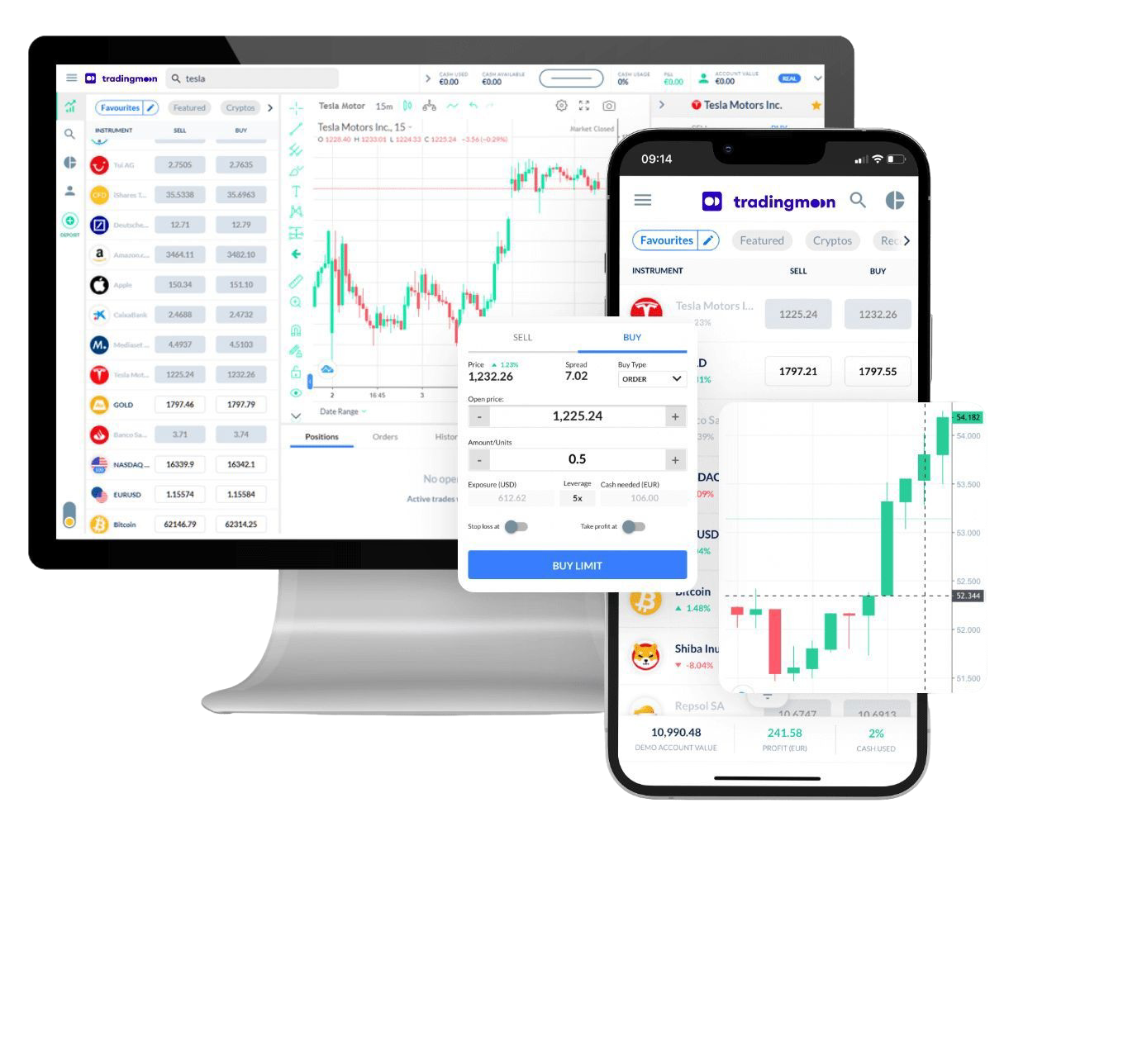
Trade [[data.name]] with TradingMoon
Hassle-free, with flexible trade sizes, and super low spreads!
- Spreads starting at 0.2!
- Average Execution at 5ms
- Easy to use platform
*Other fees may apply.
Why Trade [[data.name]]
Make the most of price fluctuations - no matter what direction the price swings and with low capital investment.
Forex

Capitalise on rising prices (go long)


Capitalise on falling prices (go short)

Trade with leverage

Trade on volatility

Enjoy huge liquidity

Manage risk with in-platform tools
Ability to set take profit and stop loss levels