


[[ data.name ]]
[[ data.ticker ]]
[[ data.price ]] [[ data.change ]] ([[ data.changePercent ]]%)
Low: [[ data.low ]]
High: [[ data.high ]]
About
History
Why Trade?
About
History
Why Trade?
EUR/JPY is a currency pair that shows how many Japanese yen (JPY) are needed to buy one euro (EUR). For example, if the EUR/JPY rate is 160, one euro is worth 160 yen, so buying EUR 1,000 would cost JPY 160,000.
The euro is the common currency of the eurozone, and its monetary policy is set by the European Central Bank (ECB). The yen is the currency of Japan, where monetary policy is set by the Bank of Japan (BoJ).
EUR/JPY is a cross-currency pair, which means it does not include the US dollar. The yen is often seen as a safe-haven currency, so the pair can react to changes in global risk sentiment as well as to ECB and BoJ interest rate decisions, inflation and growth data.
The euro was introduced on 1 January 1999, and EUR/JPY has been traded since then. Before the euro, the yen was traded against the national currencies of the eurozone countries.
Over the years, EUR/JPY has moved through wide swings. During the 2008 global financial crisis, the yen strengthened as investors looked for safe havens, and the euro fell sharply against it. The eurozone debt crisis that began in 2010 also weighed on the euro.
Monetary policy has played a major role. The Bank of Japan introduced a negative interest rate policy in 2016 and ended it in March 2024 with its first rate hike in 17 years. Central bank policy, risk sentiment and economic data continue to drive EUR/JPY. Past performance is not a reliable indicator of future results.
Traders follow EUR/JPY because it pairs the euro with the yen, a currency often seen as a safe haven. Interest rate decisions by the ECB and the Bank of Japan, economic data releases and changes in global risk sentiment can move the pair. These price movements can create trading opportunities, but they can also lead to losses, especially when trading with leverage.
EUR/JPY can be traded as a CFD (contract for difference), which lets you speculate on price movements in either direction without owning the underlying currencies. CFDs are leveraged products and carry a high level of risk.
Other currency pairs that traders may consider include EUR/USD, GBP/USD, USD/JPY and AUD/USD. The choice of currency pair depends on factors such as liquidity, volatility and each trader's strategy and risk tolerance. It's important to research any currency pair carefully and understand the risks before trading.
| Swap long | [[ data.swapLong ]] points |
|---|---|
| Swap short | [[ data.swapShort ]] points |
| Spread min | [[ data.stats.minSpread ]] |
| Spread avg | [[ data.stats.avgSpread ]] |
| Min contract size | [[ data.minVolume ]] |
| Min step size | [[ data.stepVolume ]] |
| Commission and Swap | Commission and Swap |
| Leverage | Leverage |
| Trading Hours | Trading Hours |
* The spreads provided are a reflection of the time-weighted average. Though TradingMoon attempts to provide competitive spreads during all trading hours, clients should note that these may vary and are susceptible to underlying market conditions. The above is provided for indicative purposes only. Clients are advised to check important news announcements on our Economic Calendar, which may result in the widening of spreads, amongst other instances.
The above spreads are applicable under normal trading conditions. TradingMoon has the right to amend the above spreads according to market conditions as per the 'Terms and Conditions'.
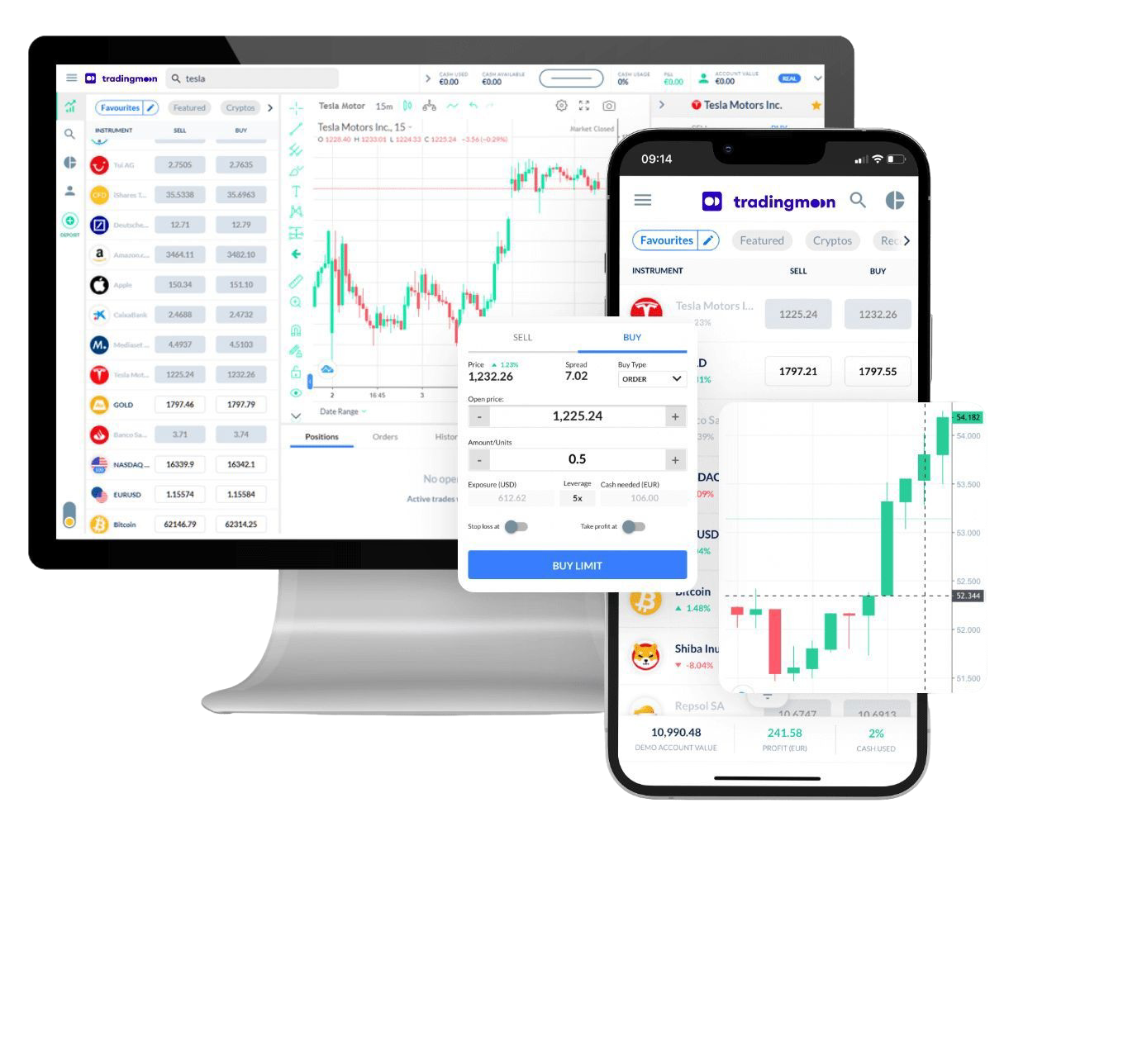
Trade [[data.name]] with TradingMoon
Hassle-free, with flexible trade sizes, and super low spreads!
- Spreads starting at 0.2!
- Average Execution at 5ms
- Easy to use platform
*Other fees may apply.
Why Trade [[data.name]]
Make the most of price fluctuations - no matter what direction the price swings and with low capital investment.
Forex

Capitalise on rising prices (go long)


Capitalise on falling prices (go short)

Trade with leverage

Trade on volatility

Enjoy huge liquidity

Manage risk with in-platform tools
Ability to set take profit and stop loss levels