


[[ data.name ]]
[[ data.ticker ]]
[[ data.price ]] [[ data.change ]] ([[ data.changePercent ]]%)
Low: [[ data.low ]]
High: [[ data.high ]]
About
History
Why Trade?
About
History
Why Trade?
The Australian dollar (AUD), often written as A$ or AU$, is the official currency of Australia and its external territories, and is also used in Kiribati, Nauru and Tuvalu. It replaced the Australian pound in 1966 and has floated freely since December 1983.
The New Zealand dollar (NZD), known as tāra o Aotearoa in Māori and often written as NZ$, is the official currency of New Zealand, the Cook Islands, Niue, Tokelau, the Ross Dependency and the Pitcairn Islands. It replaced the New Zealand pound in 1967 and has floated since March 1985. It is often called the "kiwi", after the bird shown on the one-dollar coin.
Australia and New Zealand are close neighbours and major trading partners, and both economies rely heavily on commodity exports. As a result, AUDNZD has often moved within a narrower range than many other currency pairs. Even so, the pair has seen periods of significant movement, usually driven by differences in interest rates, economic growth and commodity prices between the two countries.
Understanding the price history of AUDNZD can help traders put current moves into context. Traders also follow major economic news, such as interest rate decisions by the Reserve Bank of Australia and the Reserve Bank of New Zealand. Past performance is not a reliable indicator of future results.
AUDNZD lets traders take a view on the relative performance of the Australian and New Zealand economies without the US dollar being part of the trade. Because the two economies are closely linked, the pair often reacts most strongly to differences in interest rate expectations between the Reserve Bank of Australia and the Reserve Bank of New Zealand, as well as to economic data from both countries. As with all forex trading, trading AUDNZD involves risk, and leveraged positions can lead to significant losses.
Traders may also wish to consider other currency pairs such as GBPJPY, which combines the British pound and the Japanese yen and is influenced by different economic factors.
| Swap long | [[ data.swapLong ]] points |
|---|---|
| Swap short | [[ data.swapShort ]] points |
| Spread min | [[ data.stats.minSpread ]] |
| Spread avg | [[ data.stats.avgSpread ]] |
| Min contract size | [[ data.minVolume ]] |
| Min step size | [[ data.stepVolume ]] |
| Commission and Swap | Commission and Swap |
| Leverage | Leverage |
| Trading Hours | Trading Hours |
* The spreads provided are a reflection of the time-weighted average. Though TradingMoon attempts to provide competitive spreads during all trading hours, clients should note that these may vary and are susceptible to underlying market conditions. The above is provided for indicative purposes only. Clients are advised to check important news announcements on our Economic Calendar, which may result in the widening of spreads, amongst other instances.
The above spreads are applicable under normal trading conditions. TradingMoon has the right to amend the above spreads according to market conditions as per the 'Terms and Conditions'.
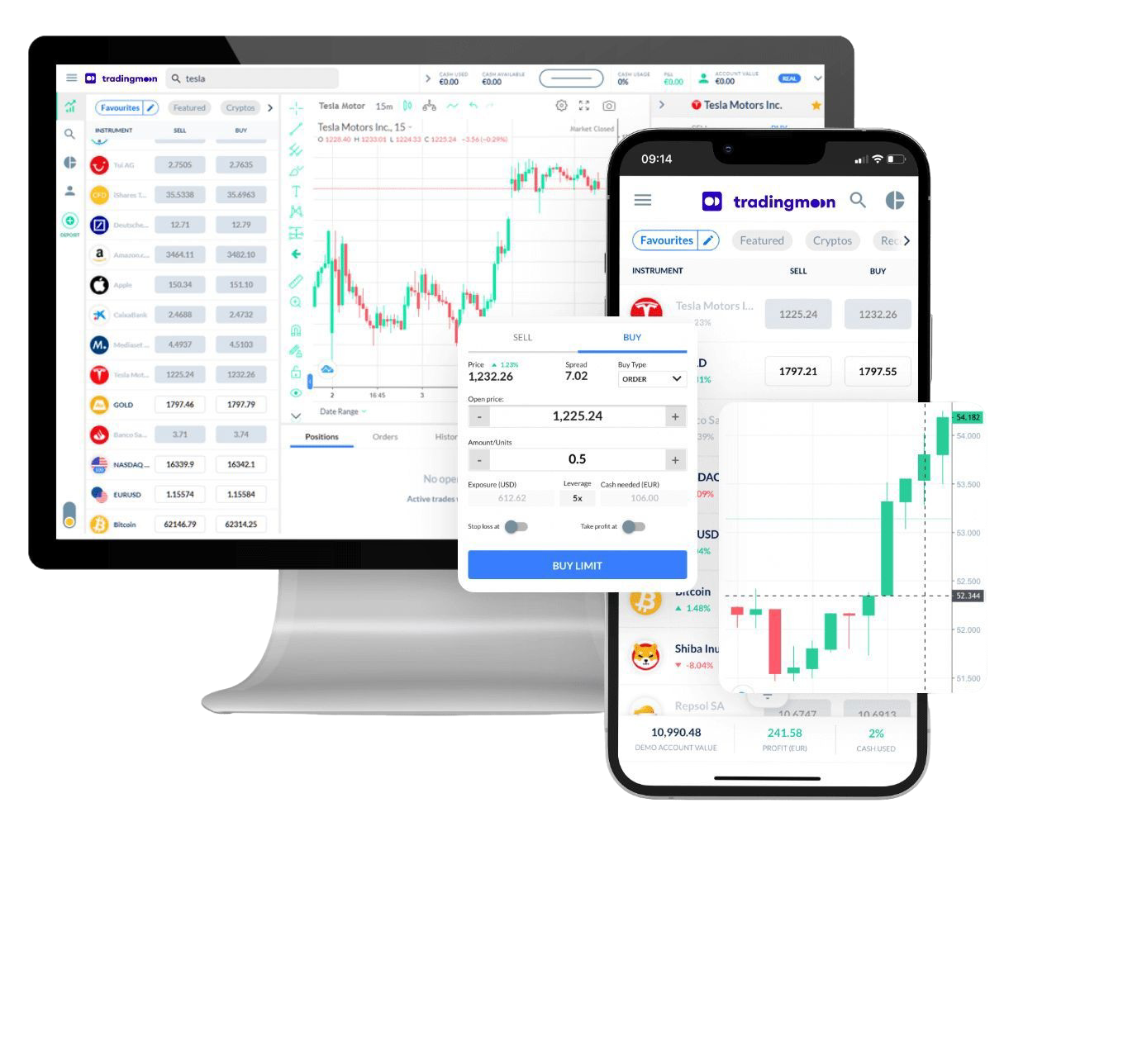
Trade [[data.name]] with TradingMoon
Hassle-free, with flexible trade sizes, and super low spreads!
- Spreads starting at 0.2!
- Average Execution at 5ms
- Easy to use platform
*Other fees may apply.
Why Trade [[data.name]]
Make the most of price fluctuations - no matter what direction the price swings and with low capital investment.
Forex

Capitalise on rising prices (go long)


Capitalise on falling prices (go short)

Trade with leverage

Trade on volatility

Enjoy huge liquidity

Manage risk with in-platform tools
Ability to set take profit and stop loss levels