


This website is operated by TM Trading Ltd, an entity regulated by the Seychelles Financial Services Authority (FSA) with License No. SD042. This website is not intended for EU residents or individuals in jurisdictions where its access is restricted by law.
By clicking "Acknowledge", you confirm that you are accessing this website on your own initiative and not in response to any direct marketing or solicitation, and you understand that you are not protected by EU regulations. You acknowledge that you are seeking information from this website under the principle of reverse solicitation, in accordance with the applicable laws of your home jurisdiction.
[[ data.name ]]
[[ data.ticker ]]
[[ data.price ]] [[ data.change ]] ([[ data.changePercent ]]%)
Low: [[ data.low ]]
High: [[ data.high ]]
About
History
Differences between Investing vs Trading
About
History
Differences between Investing vs Trading
Allianz was founded in 1890 by Wilhelm von Finck and other shareholders. The company is headquartered in Munich, Germany. As of the end of 2025, Allianz had around 156,000 employees worldwide and served around 97 million private and corporate customers in almost 70 countries. Allianz is one of the world's largest financial services companies.
It offers a wide range of products and services, including insurance, investment management, and banking. Allianz is also active in many industries, such as automotive, health care, and real estate. In addition to its core businesses, Allianz also has a number of subsidiaries, joint ventures, and affiliates.
Allianz's share price has seen significant ups and downs over the years. The shares fell sharply during the 2008–2009 global financial crisis and came under pressure again during the eurozone debt crisis in 2011. Since then, the share price has risen considerably overall, with periods of volatility along the way.
Like other insurers, Allianz's share price can be affected by factors such as its financial results, interest rates, claims from natural catastrophes and general market conditions.
There are several key differences between investing and trading Allianz CFDs. When you invest in a company, you are buying shares of that company and becoming a shareholder. This means that you are entitled to a portion of the company's earnings and have a say in how the company is run. When you trade Allianz CFDs, you are speculating on the price movement of the underlying asset and do not own any shares in the company. You also don't have any voting rights or influence over how the company is managed.
Another key difference is that investors typically hold onto their shares for a long period of time, while traders often close out their positions within minutes or hours. This is because investors are trying to ride the long-term waves of the market, while traders are trying to capitalize on short-term price movements.
Finally, investors typically focus on a few key companies or sectors that they are knowledgeable about, while traders may buy and sell a wide variety of assets in order to take advantage of opportunities as they arise.
Loading
| Swap long | [[ data.swapLong ]] points |
|---|---|
| Swap short | [[ data.swapShort ]] points |
| Spread min | [[ data.stats.minSpread ]] |
| Spread avg | [[ data.stats.avgSpread ]] |
| Min contract size | [[ data.minVolume ]] |
| Min step size | [[ data.stepVolume ]] |
| Commission and Swap | Commission and Swap |
| Leverage | Leverage |
| Trading Hours | Trading Hours |
* The spreads provided are a reflection of the time-weighted average. Though TradingMoon attempts to provide competitive spreads during all trading hours, clients should note that these may vary and are susceptible to underlying market conditions. The above is provided for indicative purposes only. Clients are advised to check important news announcements on our Economic Calendar, which may result in the widening of spreads, amongst other instances.
The above spreads are applicable under normal trading conditions. TradingMoon has the right to amend the above spreads according to market conditions as per the 'Terms and Conditions'.
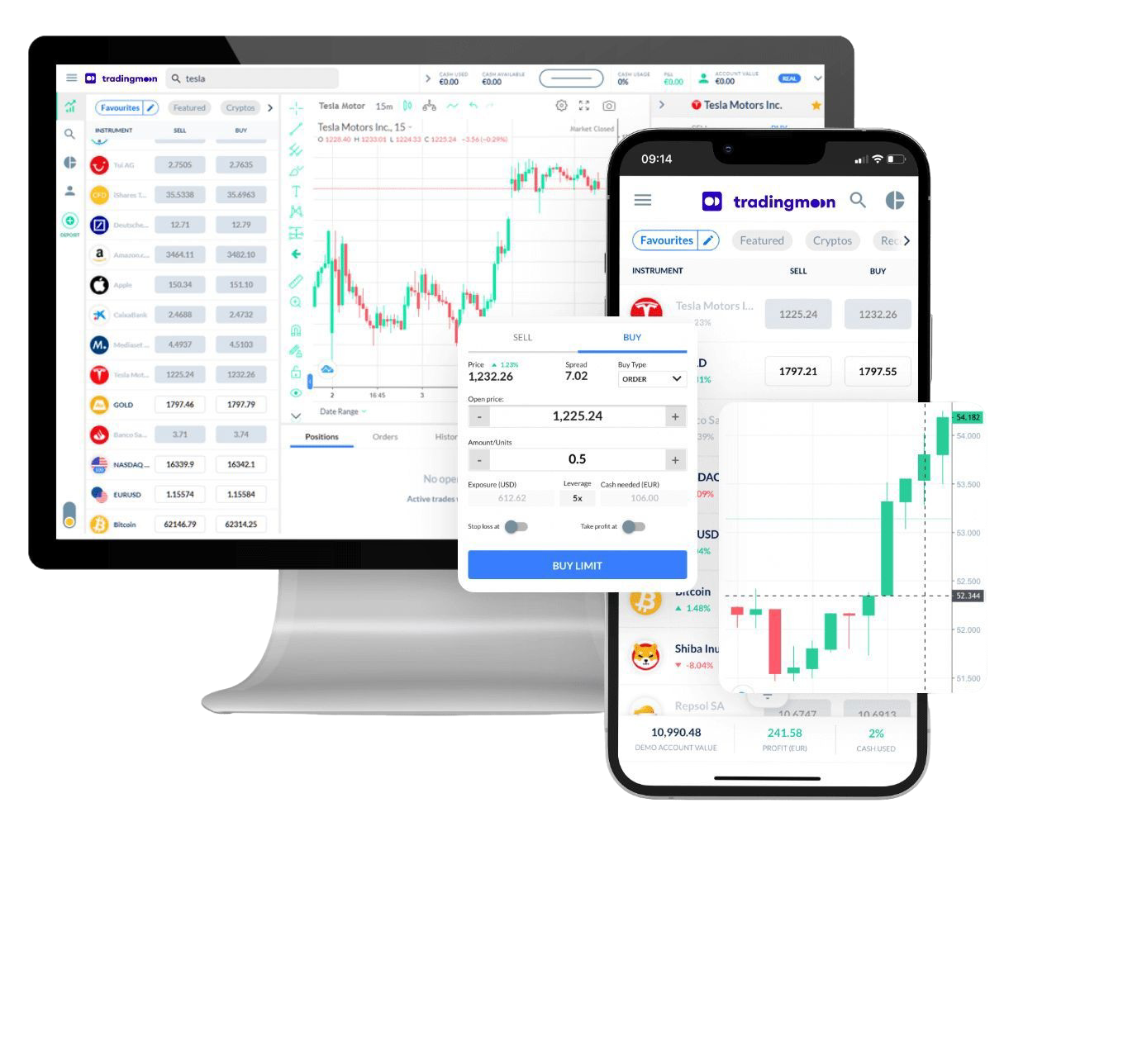
Trade [[data.name]] with TradingMoon
All Hassle-free, with flexible trade sizes and with zero commissions!*
- Trade 24/5
- Minimum margin requirements
- No commission, only spread
- Fractional shares available
- Easy to use platform
*Other fees may apply.
FAQs
Which are the competitors of Allianz shares?
Allianz is one of the largest insurance companies in the world, with a strong presence in Europe, North America, and Asia. The company offers a wide range of insurance products, including life insurance, health insurance, property and casualty insurance, and more. Allianz is a publicly traded company, listed on the Frankfurt Stock Exchange.
Some of the company's main competitors include AXA, Zurich Insurance Group, and Generali. These companies are all large, global insurers with a strong presence in multiple markets. Allianz competes with them in terms of product offerings, pricing, and distribution channels.
Who owns most Allianz shares?
Allianz is a publicly traded company, and its shares are held by a wide range of institutional and private investors. Shareholders must notify Allianz when their voting rights cross certain thresholds, and Allianz publishes these notifications. According to these notifications, the asset manager BlackRock, Inc. is one of Allianz's largest shareholders.
Do Allianz shares pay dividends?
Yes, Allianz pays an annual dividend to its shareholders. For fiscal year 2025, it paid a dividend of €17.10 per share in May 2026, up from €15.40 for fiscal year 2024. The dividend is decided each year by the Annual General Meeting, and dividends are not guaranteed.
Why Trade [[data.name]]
Make the most of price fluctuations - no matter what direction the price swings and without capital restrictions that come with buying the underlying asset.
CFDs
Equities

Capitalise on rising prices (go long)


Capitalise on falling prices (go short)

Trade with leverage
Hold larger positions than the cash you have at your disposal

Trade on volatility
No need to own the asset

No commissions
Just low spreads

Manage risk with in-platform tools
Ability to set take profit and stop loss levels