


[[ data.name ]]
[[ data.ticker ]]
[[ data.price ]] [[ data.change ]] ([[ data.changePercent ]]%)
Low: [[ data.low ]]
High: [[ data.high ]]
About
History
Differences between Investing vs Trading
About
History
Differences between Investing vs Trading
BASF SE is a German chemical company and one of the largest chemical producers in the world. It was founded in 1865 and is headquartered in Ludwigshafen, Germany. BASF makes a wide range of products, from basic chemicals and plastics to catalysts, battery materials, nutrition and personal care ingredients, and crop protection products and seeds. Its customers include the automotive, construction, agriculture, consumer goods and electronics industries.
A key part of BASF's business model is its Verbund system, in which production plants are linked so that the products and energy of one plant can be used by others. Its largest Verbund site is in Ludwigshafen, and in 2025 BASF started up key plants at a new Verbund site in Zhanjiang, China. In 2025, the BASF Group reported sales of €59.7 billion. Markus Kamieth has been Chairman of the Board of Executive Directors since 2024. BASF shares are listed on the Frankfurt Stock Exchange, are part of the DAX index and are available on TradingMoon as BAS.DE.
BASF was founded in 1865 in Mannheim as Badische Anilin- & Soda-Fabrik to produce dyes, and soon moved its production to Ludwigshafen on the other side of the Rhine. In the early 20th century it played a central role in developing the Haber-Bosch process, and in 1913 it opened the first plant to produce ammonia on an industrial scale in Oppau, which made synthetic fertilisers possible. In 1925 BASF became part of the IG Farben group. After IG Farben was broken up following the Second World War, BASF was re-established as an independent company in 1952.
In the following decades BASF expanded worldwide through investments and acquisitions, including Ciba in 2009, Cognis in 2010 and seed and crop protection businesses from Bayer in 2018. In 2024, its oil and gas company Wintershall Dea transferred its exploration and production business to Harbour Energy, in which BASF received a stake. Since 2024, BASF has been reorganising under its "Winning Ways" strategy, which includes cost cuts and preparing a stock market listing of its agricultural business.
Like other chemical companies, BASF's share price can be affected by economic cycles, energy prices and demand from key industries. Before trading BASF shares, consider the risks involved.
When you invest in BASF shares, you buy the shares themselves and become a shareholder. You can benefit if the share price rises and may receive dividends, and investors usually hold their shares for the long term.
When you trade CFDs on BASF, you don't own the shares. Instead, you take a position on whether the price will rise or fall. CFDs are leveraged, which means you only need to deposit a fraction of the position's value as margin, but profits and losses are calculated on the full position size, so losses can add up quickly. CFD positions are usually held for shorter periods, and keeping them open overnight can involve financing costs. Investing involves a risk of losing capital.
| Swap long | [[ data.swapLong ]] points |
|---|---|
| Swap short | [[ data.swapShort ]] points |
| Spread min | [[ data.stats.minSpread ]] |
| Spread avg | [[ data.stats.avgSpread ]] |
| Min contract size | [[ data.minVolume ]] |
| Min step size | [[ data.stepVolume ]] |
| Commission and Swap | Commission and Swap |
| Leverage | Leverage |
| Trading Hours | Trading Hours |
* The spreads provided are a reflection of the time-weighted average. Though TradingMoon attempts to provide competitive spreads during all trading hours, clients should note that these may vary and are susceptible to underlying market conditions. The above is provided for indicative purposes only. Clients are advised to check important news announcements on our Economic Calendar, which may result in the widening of spreads, amongst other instances.
The above spreads are applicable under normal trading conditions. TradingMoon has the right to amend the above spreads according to market conditions as per the 'Terms and Conditions'.
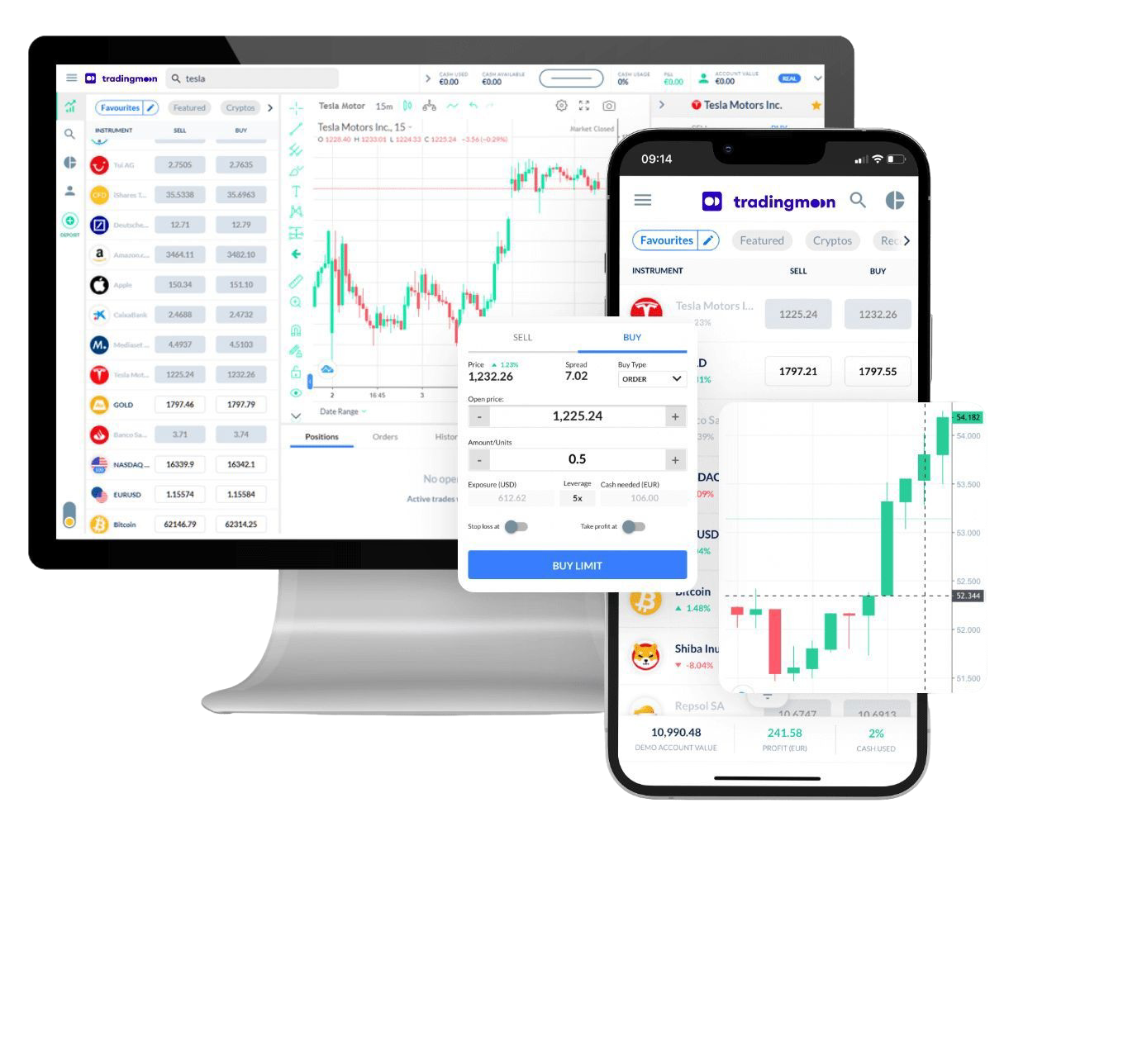
Trade [[data.name]] with TradingMoon
All Hassle-free, with flexible trade sizes and with zero commissions!*
- Trade 24/5
- Minimum margin requirements
- No commission, only spread
- Fractional shares available
- Easy to use platform
*Other fees may apply.
FAQs
What are the main factors affecting BASF's share price?
BASF's share price is influenced by both company-specific and external factors. Company-specific factors include sales growth, earnings per share, margins, progress on cost savings and portfolio changes such as acquisitions and disposals.
External factors include global industrial demand, especially from the automotive, construction and agriculture sectors, energy and raw material costs, commodity prices, currency movements and the economic situation in Europe and China.
Who owns BASF shares?
BASF has a broad shareholder base, with more than 900,000 shareholders and a high free float. According to the company's analysis at the end of 2025, around 45% of the share capital was held by private investors, almost all of them in Germany, and institutional investors from the United States and Canada made up the largest regional group of institutional investors, with around 23%.
BASF shares are part of Germany's DAX index. For the latest shareholder structure, see the investor relations section of BASF's website.
Do BASF shares pay dividends?
Yes. BASF pays a dividend once a year. For the 2025 business year, it paid €2.25 per share on May 6, 2026, the same amount as for 2024. Under its current policy, BASF aims to pay a dividend of at least €2.25 per share each year from 2025 to 2028, alongside share buybacks.
Dividends are not guaranteed. They are proposed by the company's boards and approved by the Annual Shareholders' Meeting, and they can change in the future.
Why Trade [[data.name]]
Make the most of price fluctuations - no matter what direction the price swings and without capital restrictions that come with buying the underlying asset.
CFDs
Equities

Capitalise on rising prices (go long)


Capitalise on falling prices (go short)

Trade with leverage
Hold larger positions than the cash you have at your disposal

Trade on volatility
No need to own the asset

No commissions
Just low spreads

Manage risk with in-platform tools
Ability to set take profit and stop loss levels