


This website is operated by TM Trading Ltd, an entity regulated by the Seychelles Financial Services Authority (FSA) with License No. SD042. This website is not intended for EU residents or individuals in jurisdictions where its access is restricted by law.
By clicking "Acknowledge", you confirm that you are accessing this website on your own initiative and not in response to any direct marketing or solicitation, and you understand that you are not protected by EU regulations. You acknowledge that you are seeking information from this website under the principle of reverse solicitation, in accordance with the applicable laws of your home jurisdiction.
[[ data.name ]]
[[ data.ticker ]]
[[ data.price ]] [[ data.change ]] ([[ data.changePercent ]]%)
Low: [[ data.low ]]
High: [[ data.high ]]
About
History
Competitors
About
History
Competitors
AMC Entertainment Holdings is one of the world's largest movie theatre chains. The company is based in Kansas, in the US, and also has numerous theatres in Europe. The history of the group can be traced back to 1920, when Maurice, Edward and Barney Dubinsky started the cinema business that later became AMC Theatres. Since then, there have been several name changes, acquisitions and takeovers.
AMC moved into drive-in movie theatres in the 1940s before gradually expanding its portfolio of locations across the US. AMC also helped to pioneer the multiplex and megaplex concepts, which allowed it to increase revenue by showing movies on several screens at the same time in a single location without needing to hire more staff.
By the 1980s, AMC had entered the UK market. Today, it has a strong presence in Europe as well as its long-standing presence in the US.
In January 2021, AMC and GME shares surged as retail investors coordinated their buying on social media. At the height of the rally, Robinhood and several other brokers temporarily restricted purchases of these stocks. Robinhood said this was because its clearinghouse deposit requirements had increased tenfold. The restrictions caused an outcry among users, and Robinhood's CEO was later questioned by US lawmakers at a congressional hearing.
A look back at the historical AMC (AMC.US) share price shows a high level of volatility, driven by factors such as changing demand for movie theatres. The rise of on-demand streaming services has put pressure on the cinema industry, although blockbuster movies continue to draw large audiences to theatres.
An example of this volatility came at the start of 2021. After AMC announced that it had raised $917 million in new funding, the stock was hit by a short squeeze that sent its price sharply higher before it fell back again.
The most notable event during this period was the "Reddit rally" in early 2021, when retail investors coordinating on social media platforms such as Reddit drove up the price of AMC and other heavily shorted stocks. AMC's share price reached its peak in June 2021.
After the rally, the share price fell steeply. Concerns over the company's financial health, the impact of the COVID-19 pandemic on the cinema industry, the issue of large numbers of new shares and shifts in investor sentiment all played a part. In August 2023, AMC completed a 1-for-10 reverse stock split.
AMC has also tried to diversify its business, for example by accepting Bitcoin and other cryptocurrencies for online payments and by showing concert films and other events in its theatres.
AMC’s competitors include, but are not limited to:
- Netflix (NFLX.US) is a global streaming giant, providing a wide range of on-demand content, including movies, TV series, and original productions. It challenges AMC by offering a subscription-based model, allowing users to access content conveniently and on their terms.
- Amazon (AMZN.US) is a multifaceted competitor, offering a broad spectrum of services, including Prime Video for streaming content and a massive e-commerce platform. Its comprehensive approach challenges AMC's traditional cinema business model by providing diverse entertainment and shopping options to consumers.
- Walt Disney (DIS.US) is another competitor, operating in the entertainment and media industry. Disney, with its vast portfolio of movies, TV networks, and theme parks, competes for consumer attention and revenue, particularly in the realm of family-oriented and blockbuster entertainment, posing a substantial challenge to AMC's cinema business.
- Sony (SNE.US) is a competitor of AMC Entertainment, operating in the entertainment and media industry. Sony's diverse portfolio includes movies, music, and gaming, directly competing for consumer attention and entertainment spending.
- Six Flags (SIX.US) competes with AMC Entertainment in the leisure and entertainment industry. As a leading amusement park operator, Six Flags offers alternative entertainment options, drawing families and thrill-seekers away from traditional cinemas.
Traders should know a stock's competitors before trading because understanding the competitive landscape helps assess a company's relative strength and potential risks. Competitor analysis provides valuable insights into market dynamics, pricing trends, and strategic positioning, aiding traders in making informed investment decisions and managing risk effectively.
Loading
| Swap long | [[ data.swapLong ]] points |
|---|---|
| Swap short | [[ data.swapShort ]] points |
| Spread min | [[ data.stats.minSpread ]] |
| Spread avg | [[ data.stats.avgSpread ]] |
| Min contract size | [[ data.minVolume ]] |
| Min step size | [[ data.stepVolume ]] |
| Commission and Swap | Commission and Swap |
| Leverage | Leverage |
| Trading Hours | Trading Hours |
* The spreads provided are a reflection of the time-weighted average. Though TradingMoon attempts to provide competitive spreads during all trading hours, clients should note that these may vary and are susceptible to underlying market conditions. The above is provided for indicative purposes only. Clients are advised to check important news announcements on our Economic Calendar, which may result in the widening of spreads, amongst other instances.
The above spreads are applicable under normal trading conditions. TradingMoon has the right to amend the above spreads according to market conditions as per the 'Terms and Conditions'.
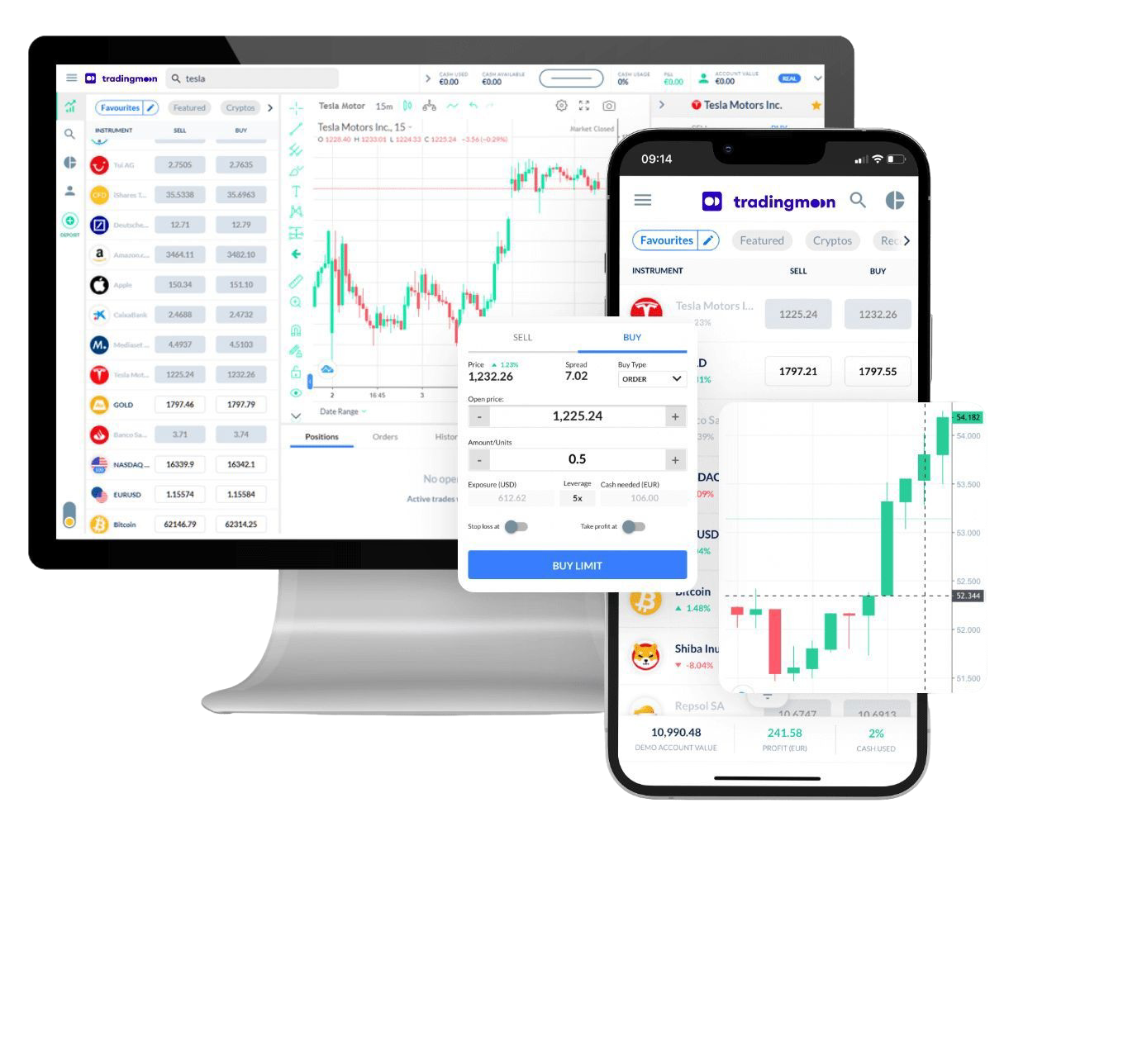
Trade [[data.name]] with TradingMoon
All Hassle-free, with flexible trade sizes and with zero commissions!*
- Trade 24/5
- Minimum margin requirements
- No commission, only spread
- Fractional shares available
- Easy to use platform
*Other fees may apply.
FAQs
Are AMC shares a good investment?
Whether AMC shares suit you depends on your goals, risk tolerance and investment horizon. TradingMoon does not provide investment advice. AMC shares have been highly volatile since 2021. The company reported a net loss of $632.4 million for 2025 and carries significant debt. Before trading, review AMC's latest financial reports and consider the risks carefully.
Who owns most AMC shares?
AMC is a publicly traded company, and its shares are held by a wide range of institutional and retail investors. China's Dalian Wanda Group, which bought AMC in 2012, sold almost all of its remaining stake in 2021. AMC's current major shareholders are listed in its filings with the US Securities and Exchange Commission (SEC).
Do AMC shares pay dividends?
No, AMC does not currently pay a dividend. Any future dividend would depend on the company's financial position and the decisions of its board, and dividends are never guaranteed.
What was the AMC short squeeze in 2021?
AMC shares exploded in value in early 2021 after a short squeeze was initiated by retail investors on Reddit. The company, along with GameStop (GME) and other companies that had been targeted by hedge funds for short selling, saw their stock prices increase dramatically as retail investors bought up shares and forced the hedge funds to cover their positions.
The AMC short squeeze was notable not only for its size and scope, but also for the fact that it was driven largely by retail investors using platforms like Robinhood.
Which are the competitors of AMC shares?
AMC's main competitors in the US cinema market include Regal, which is owned by Cineworld, and Cinemark. Cinemas also compete with streaming services and other forms of home entertainment.
AMC has invested in premium formats such as IMAX and Dolby Cinema, as well as reserved seating and online ticketing.
Time for a new meme bull market in AMC?
No one can predict whether another meme-stock rally will happen. Since 2021, AMC has issued large numbers of new shares to raise capital, and in 2022 it also created AMC Preferred Equity Units (APEs).
In August 2023, AMC carried out a 1-for-10 reverse stock split and converted its APEs into common shares, which diluted existing shareholders. Past performance is not a reliable indicator of future results.
What happened to AMC's APE units?
AMC Preferred Equity Units (APEs) were created in 2022 to allow AMC to raise more capital. In August 2023, after a Delaware court approved a settlement of shareholder lawsuits, the APEs were converted into AMC Class A common stock and delisted from the New York Stock Exchange. The conversion increased the number of common shares and diluted existing shareholders.
Is AMC profitable?
No. AMC reported a net loss of $632.4 million for the full year 2025, compared with a net loss of $352.6 million in 2024. The company said the larger loss was mainly due to non-cash charges related to its July 2025 refinancing.
Will AMC go bankrupt?
AMC has not filed for bankruptcy, and it is not possible to predict whether it will. The company carries significant debt and has reported losses in recent years. Rival Cineworld, the owner of Regal, filed for Chapter 11 bankruptcy protection in 2022.
Investors can follow AMC's financial reports for updates on its debt and liquidity.
How does the AMC stock split work?
In August 2023, AMC carried out a 1-for-10 reverse stock split. Shareholders received one new share for every ten shares they held, and the share price was adjusted by the same factor, so the value of a holding did not change as a result of the split itself. Together with an increase in the number of authorised shares, the reverse split allowed AMC to convert its APE units into common stock.
How to trade AMC?
To trade AMC shares, you can follow these general steps:
1. Open a trading account with a reputable online broker such as TradingMoon.
2. Fund your account with the desired amount of capital.
3. Research the stock’s performance, news, and market trends.
4. Decide on your trading strategy, whether it's day trading, scalping trading, copy trading, etc.
5. Use your trading platform to place buy or sell orders for the shares.
6. Monitor the market closely and adjust your positions as needed.
7. Keep track of any news or announcements that may impact the stock price.
8. Consider setting stop-loss orders to manage risk.
Is AMC financially healthy?
The financial health of AMC Entertainment Holdings Inc. has been a subject of scrutiny, particularly due to the challenging environment faced by the movie theatre industry during the COVID-19 pandemic. AMC's financial health could fluctuate based on factors like revenue, profitability, debt levels, and cash flow. It is crucial for investors and traders to assess AMC's financial statements, quarterly reports, and other relevant financial metrics. Additionally, monitoring industry trends, consumer behaviour, and the company's ability to adapt to changing market dynamics is important in evaluating its financial health.
What is the profit margin of AMC?
AMC's net profit margin has been negative in recent years because the company has reported net losses. In 2025, AMC reported a net loss of $632.4 million on revenue of $4,848.9 million, a net margin of about −13%. Profit margin shows how much of a company's revenue remains as profit after all expenses.
Why Trade [[data.name]]
Make the most of price fluctuations - no matter what direction the price swings and without capital restrictions that come with buying the underlying asset.
CFDs
Equities

Capitalise on rising prices (go long)


Capitalise on falling prices (go short)

Trade with leverage
Hold larger positions than the cash you have at your disposal

Trade on volatility
No need to own the asset

No commissions
Just low spreads

Manage risk with in-platform tools
Ability to set take profit and stop loss levels